Saturday, February 18, 2012

What is "Airport Reading"?


Dominique Browning has a fascinating piece in the New York Times today called "Learning to Love Airport Lit." The article is a persuasive (and also humorous) take on the most effective kinds of airport reading. In Browning's words, the ideal airport reading involves "plain, old-fashioned, unrelenting, compelling storytelling. You’ve got to reach for the best-seller shelves." Browning is really concerned with the utmost practical aspect of airport/airplane reading: what kind of texts are the best for killing time. Of course, there's also a variety of airplane reading about the time that kills: aircraft safety briefing cards tell us through frame-by-frame illustrations how we might survive plane crashes—including, in an embedded mise en abyme, the actual reading of the text itself (see image above).

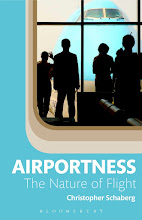
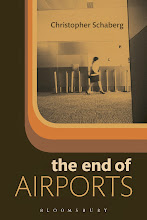
I've been thinking about this issue incessantly over the past ten years, and my new book takes up this matter explicitly in the first chapter, which is called "What is Airport Reading?" (You can even read that chapter as the free preview sample Continuum is providing for a time.)

What's so curious to me about Browning's article is how the question of what to read in airports and on airplanes always relies on an implicit, savage indictment of the state of air travel as we have created it: it's readily and widely admitted to be "endlessly unpleasant" (in the words of Browning). Which is to say, we admit and even insist upon the awfulness of air travel, and then try to find ways to distract ourselves from its awful duration, expected drudgery, and always possible (if not probable) delays. In so doing, we impede our abilities to actually change the realities of air travel. With such a fixed determination on all the ways that air travel is wretched, it's hard to imagine it ever being any different.

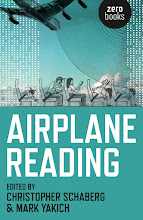
My friend Mark Yakich and I have been taking a slightly different approach over at our website Airplane Reading. (There's something to be said, too, about the important differences and overlaps between airport reading and airplane reading—but I'll save that for another post.) Mark and I are collecting people's stories about air travel—stories from everyday travelers, airline & airport workers, and professional writers alike—with the aim to eventually publish a selection of these pieces in a book designed for airport bookstores. It will be a book that reflects directly and thoughtfully on the very act of flight itself. We wonder if by harnessing the storytelling urge within the experiences of air travel (as all the internal metaphors of Browning's article suggest), we might actually be able to change how people fly—hopefully for the better.

Friday, February 17, 2012

The Airports in "Somewhere"

About a year ago, the New Yorker film critic David Denby took me to task for falling into "the classic idiocy of auteurism" concerning Sofia Coppola; I had written a retort to his review of Coppola's film Somewhere. Well I just watched Somewhere for the second time, and I am even more convinced than ever that it is a brilliant film, and far more subtle and sly than Denby gives it credit for.

I take my cue—perhaps not surprisingly—from the way the culture of flight is evoked in the film. At one point, our main character Johnny Marco has to fly to Milan for a publicity junket of sorts. We get two airport scenes: one as Johnny and his daughter Cleo enter LAX, and another as Johnny & Cleo exit Malpensa airport. The flight, on the other hand, is completely elided:

They arrive at LAX,


one second elapses,


and they are in Milan, trudging through the baggage claim.

Perhaps these brief scenes would not stand out so much if they were not placed in the exact middle of the film. As it is, Coppola has set an international air travel spree at the precise center point of this narrative: the artwork balances on this almost instantaneous vehiculation across vast space and considerable time. It is a journey evoked and yet entirely undermined by two brief passages through the gritty endpoints we recognize as cavernous and bland terminal-scapes: one for DEPARTURES, and the other for ARRIVALS. Everything else is left out.

By this move Coppola shows us just what she means by the phrase "postmodern globalism"—a phrase explicitly mentioned at one point in the film, and received with a look of exasperated bewilderment by Johnny.

Postmodern globalism
: it might at first sound like an ironic bit of academic jargon dropped into the film to demonstrate just how cut-off from thought Johnny Marco is. But there's actually something to take from this little utterance, and a literary lineage to trace.

Globalism isn't new, of course, and it might not even be 'modern'. For the sake of this inquiry, though, let's track one way that globalism can be seen to shift from the modern to the postmodern. Ernest Hemingway's iconic Modernist novel The Sun Also Rises famously explores the malaise of American expatriates in Paris and Spain in the mid-1920s. The main character of that novel, Jake Barnes, is wounded from an airplane accident: he was a military pilot who flew "on a joke front" of the war. For Hemingway, modern globalism involves humans who are charged to fly planes in the service of conflicts of dubious origins and ends.

Thirty years later, James Baldwin's novel Giovanni's Room chronicles another tale of wandering Americans who are in search of lost identity, again in Paris and Spain. At one point in the novel the character Hella announces that she took a commercial flight in Spain and would never do it again: she claims the plane shook like a Model-T, and it probably was a Model-T at one point before it became an airplane. Baldwin's globalism in this scene marks another stage on the way to the postmodern: the materials of history (here, a Ford automobile) have been transported, updated, and recycled into another means of travel—but these materials are still haunted by latent limitations and deficiencies. The lampooned passenger aircraft in Giovanni's Room functions as an uncertain means of flight—not as existentially dangerous as Hemingway's fighter plane, yet perhaps more disorienting for how it seems to scramble senses of time, space, and belonging (an old car and a newer airplane; Detroit and Spain; being a tourist and being a tourist trying to escape an initial point of tourism).

Now consider again the airports in Somewhere. We could have easily had scenes of Johnny and Cleo in a First Class sleeper cabin on a Boeing 777—such scenes would have fit right into the hotel psychogeography explored by the rest of the film. But by placing the flight in a cinematic lacuna, by only showing us the airport passages, Coppola effectively exposes the postmodern globalism at work in the film: this is a world where high-speed air travel is no longer a matter of consciousness—it's not even experienced. It's completely taken for granted.

If Hemingway was showing us how people repressed early airborne-inflicted trauma, and Baldwin showed us how the increasing banality of flight meshes with increasingly global (non)identity, Coppola shows us a new phase: flight driven down into the unconscious. In the land of Somewhere, air travel is everywhere and nowhere at once. Air travel is the absent presence in the film, and placed as it is at the exact center point of this story, it may very well be the key to the mystery of global postmodernism. A key, however, that the more we turn, the more it seems to throw itself away.

Another New Yorker critic, Richard Brody, praised Somewhere for how "internalized" the film is. As Brody puts it, "at the same time as the shots show a reality accessible to all, they seem wrenched from the psyches of the characters." Brody goes on to describe his experience of the film as "feeling as if I had just been cruising around in a high-powered vehicle for an hour and a half, experiencing a strangely original ride through familiar grounds, a peculiar and delightful blend of the grippingly concrete and the dreamily abstracted." Brody is most obviously alluding to the black Ferrari that Johnny Marco drives around throughout the film; but I wonder if, on another level, Brody's "high-powered vehicle" is also the thundering jetliners that contemporary life has come to internalize so well.

An ordinary plane sighting, Audubon park, New Orleans, 17 February 2012

Tuesday, February 14, 2012

Airport (as) Art

Airport (as) Art, Louis Armstrong International

Joe Sharkey gave my book a kind mention in his column in The New York Times today, "Handy Travel Tips From Those in the Know." Joe had asked me to contribute "an actually useful air travel tip" for this column, and what I came up with was this:

Pay attention to airport art. These days most airports feature wonderful public art installations, and so you can think of your time spent in the airport as an art walk of sorts. If you find yourself in a decaying concourse with no art in sight, don't worry: you are actually part of a giant, living art piece—this is the architectural matrix and social swirl that we recognize as airport life.

It may not seem entirely useful, but I really do mean this. It might sound easier said than done: to take time to pause and enjoy the airport (as) art. But I think that moving through airports with an eye toward abstractions of form, light & color, assembling shapes, movement, and patterns can actually change the experience of flight for the better.

In her book On Beauty, Elaine Scarry claims "at the moment we see something beautiful, we undergo a radical decentering." It may seem like a stretch to go to the airport looking for beauty, but suppose that in the midst of hustling from security checkpoint to departure gate you could actually achieve such a sensation? Of course, the problem is that such an experience can arrest you, and make forward motion suddenly difficult: you've been radically decentered, and are no longer in control of your own body. This isn't the best state, perhaps, to be traveling in. But maybe, with practice, it could inspire a different form of air travel, one more open to contingency and flux.

Contingency and flux: these are words that no traveler (or worker) in their rightful mind wants to contemplate at the airport, but maybe we just need a focal adjustment, or to be open to what Scarry calls "aesthetic fairness": a lateral regard for things that quickly becomes an ethical stance, too, because you are not as quick to disregard something's value. In On Beauty Scarry goes on to add that "radical decentering might also be called opiated adjacency." What would it mean to consider airport scenes not as purely functional (or dysfunctional) spaces, but as adjacent entities in dynamic relation to our seemingly separate movements and mindsets? What would it mean to really inhabit and look at airports as art, spilling all around?

Monday, February 6, 2012

It's in the air

A short essay about my airport work—cleaning out aircraft seat-back pockets at night—is in the current issue of Narrative magazine.

Meanwhile, over at Room 220 Nate Martin recently discussed the fantastic atmospheric photographs of JFK by Sophie Lvoff, from a haunting series called "For Don DeLillo."
(c) Sophie Lvoff

Lvoff seems to be making a point about the heaviness of the air around airports. So much empty space, so full of meaning.

Speaking of visual things, I finally saw the film Moneyball, and was completely thrilled to see an airport scene that fuses The Textual Life of Airports with my current book project on Brad Pitt:


In this scene, Pitt's baseball team general manager Billy Beane is trying to reassure his daughter Casey (played brilliantly by Kerris Dorsey) that he's not in trouble. (Beane's job is definitely on the line at this point in the film.) They are in the Oakland airport, with Casey getting ready to board a plane; she's an "unaccompanied minor," so the father is allowed to accompany her to the boarding gate. Here's the dialogue:
Billy Beane: "Do I look worried?"

Casey: "Yeah."

Billy: "...'cause you're getting on an airplane; those things crash all the time."
This is a classic example of what the journalist Dennis Lim has rightly called Brad Pitt's "wild card" quality. This is part of the mythology of Brad Pitt: his ability (often in single roles) to oscillate incredibly between cool, collected reason and erratic, emotionally charged physicality.

In Moneyball Pitt represents an adoring father, and his professional recklessness is meant to be entirely compartmentalized: Billy Beane is trying to change the game of baseball and regularly throws plastic chairs into walls at the stadium; but the bonding scenes of Pitt and Dorsey seem to suggest that he leaves his rogue attitudes at the office (except for one scene in which he makes Casey a ridiculously huge ice cream sundae—but we'll let that one slide).

Yet in the scene above, a little glimpse of Tyler Durden bursts into view. In this brief utterance, Pitt sends up commercial air travel and mocks it as a dubious project. The sterile white background of the scene—the generic concourse ambiance—underscores the sentiment here, as the exclusive privilege of flight is shown to be something rather drab and non-distinct. And Pitt's characteristic sarcasm and dark humor punctuate the scene with something else: a specter of horrible violence (the plane crash) lurking just beyond the frame, but well within the realm of possibility.

This scene in Moneyball works somewhat like the airport appearances in the Hardy Boys airport mysteries that I discuss in chapter 3 of my book: they jam together bland terminal backgrounds with looming explosions and violence. This problem also appears in a provocative sculpture by the artist Srdjan Loncar, "Abstraction I" (2003):


This piece is a three-dimensional collage—or in Loncar's words, a "distorted mosaic"—made from photographs of actual airplane disasters. It juxtaposes in a single object the mundane surfaces of flight and their distended flaring ends. It is interesting to note that though its completion date was 2003, the sculpture was conceived prior to 2001. And of course we must note that Moneyball takes place in 2002—Pitt's offhand reference to plane crashes cannot help but be loaded with the cultural baggage of that moment. It's in the air.