Monday, September 8, 2014
Waiting for books in transit
Somewhere outside of New York two boxes of books sit on a truck, or in an airplane hold, in transit. Perhaps they are at the bottom of a stack of other boxes, pressed down upon, suffocating. Or maybe they rest happily at the top, or somewhere indifferently in between. Maybe they have been tossed recklessly into a dark musty storage container and lie askew. Possibly they have already separated, and are following their own trajectories....
The contents of these boxes is this book whose cover is shown above, the Brad Pitt book, over ten years in the making, a weird and wild assemblage of essays on the actor and celebrity. It's either a field-changing, definitive study of a most popular figure...or it's simply another edited collection by obsessed and arguably deranged academics. Or else it is something else entirely. It might be all three of these things.
My editor in New York emailed me the other day to say she'd seen it, held it, and that it came out great—and here I wait, practically holding my breath, for the box to arrive. Waiting to hold it in my hands, to flip its pages and see what sort of beast it is that I'm at least partially responsible for creating.
I recently wrote a small piece on the book for the site Everyday Analysis, and my co-editor Robert Bennett composed a post for the Bloomsbury Film & Media Studies blog. These are two takes on the project now that we've been away from it for a few months. Still, you'll see that it left its marks on us.
Now there's nothing more to do but wait. We must wait, wait for them to be trundled across the country, a box to New Orleans and a box to Bozeman, Montana. And then, when they arrive, what then?
Tuesday, July 29, 2014
Revisiting Bozeman
I've just returned to Michigan from Bozeman, Montana, where I revisited the airport I worked at over ten years ago. So much was the same, and yet there were also innumerable differences everywhere. I was there to observe and write, and I spent several hours wandering around taking pictures, jotting down notes. I met with the Airport Director Brian Sprenger, and he talked to me about recent trends and challenges; then he gave me a tour, focusing specifically on the major expansion and redesign of a few years ago. I was particularly excited to see the new high-tech baggage makeup area behind the check-in counters, with its overhead conveyors and multiple drop-points. When I worked at the airport, moving baggage around was a pretty ad-hoc endeavor—at least compared to the new system.
It was an emotionally intense trip (for reasons that I won't get into here), and strange if also invigorating to see the airport, 'my' airport, this relatively minor travel site that has been somewhat major for me, this place I've written about and thought about so much over the past several years.
What struck me almost immediately upon my arrival was the indifference of the airport. It's just an airport doing its job, moving people in and out of the state—just like it always has, cooly accepting eager fly fishermen and crisp cowboys (I'm using the masculine here on purpose), and then a few days later spiriting these same forlorn souls away in tightly packed tubes.
And yet...there are things going on here that are not only unique to Bozeman, but which are indicative of broader currents and snags in the culture of flight. I'm writing about these things as a way to conclude my book The End of Airports, which sweeps from my own ethnography of the airport in 2001-2003, to more current episodes and dilemmas that riddle air travel.
My tagline for this book is that I'm not writing an obituary for airports, but more like a mystery. What are these gray places we pass through, only always to leave behind in our minds? What makes these concentrated nodes of hubris and gaudiness at once so remarkable and so forgettable? How do we inhabit their ambiguous boundaries? Where do airports begin, and where do they end? How does air travel fit into our era of 'new media', where things move so much faster than the speed of planes?
Sunday, May 25, 2014
Obligatory blog update
summer home
Twitter feels more and more useful as a place to write/think/connect, but I still feel the need to update this blog from time to time. So, out of a strange sense of archival obligation, here's what I've been up to lately:I'm back in Michigan for the summer, where I'm finishing up _Deconstructing Brad Pitt—we're in the final proofreading stages now.
proofs
I'm also working on Object Lessons, as well as a few other writing projects of my own. Later this summer I'm taking a research trip to Bozeman, Montana, to write about the airport (BZN) ten years after I worked there. I have no idea what I'll find, but I'm excited to be there, to wander around and observe. My plan is for whatever I write about BZN to become the concluding part of the book I'm calling The End of Airports. The book is sort of a prequel and a sequel to The Textual Life of Airports (if that makes sense). Along other airport lines I'm preparing a course I'm teaching this coming fall at Loyola, an Honors seminar called "Interpreting Airports." I taught a first draft of this class this past semester, and it was a blast; I'm hoping it becomes one of my staple courses.
Whenever I'm back in Michigan I stumble on old books from my childhood. I think one day I may put together a course on children's literature, and focus especially on some of the weirder, out-of-print ones—like this one, Timothy's Dream Book by Pierre Le-Tan, which I read to my son Julien the other night, recalling each page as I read it again with a certain uncanny delight:
Timothy's Dream Book
morels in the woods
Finally, there's the new roommate! We're getting to know Camille, who is almost eight weeks old now and starting to feel like a real part of our daily rhythms and routines.
Camille & Julien
Since having dinner with Kathryn Bond Stockton a few months ago, and after listening to her terrific talk at Tulane on representations of "the queer child," I've been thinking a lot about 'the child' as an alien thing...and considering how I might write something about this topic, sometime in the near future. But really, for now, this summer I'm trying to clear my desk of things and take some actual time off.
Tuesday, March 11, 2014
Alone, With Craft
A Singapore Airlines Boeing 777 First Class Suite
The New Inquiry has just published a new essay of mine, called "Escape Velocity," about two stories that appeared on the Internet over the past couple months: the Boeing 777 made out of manila folders, and Jason E. Harrington's essay about his former job with the TSA and subsequent ascension into an esteemed MFA program. These are both ephemeral, viral-for-a-day stories that involve air travel, and various friends and students alerted me to them when they started making the rounds.
My analysis of Luca Iaconi-Stewart's intricate model airplane was inspired by my adoption of this story in my current class at Loyola, Interpreting the Airport: we discussed this curious story, and talked about what made this plane (and the way it was photographed and displayed on the CNN website) so captivating and strange. My students had such terrific insights and responses to the story, and in class I started writing (with their input) what would become the first part of the essay.
In my other course this semester, Contemporary Nonfiction, I assigned Harrington's essay, in particular for how it enfolds the act of writing (and the desire to be a 'writer') into the broader problem at hand, i.e. the TSA and its attendant travesties involving the full body scanners. My students in that class responded very well to this piece, noting how the author used the occasion of the unpopular government agency and airport security to bolster and boost his own budding writing career; we've been talking a lot in this class about the possibilities, necessities, and limits of self-promotion (especially with social media), and what it means to write nonfiction about a discrete topic while also including the topic of oneself as writer in the writing. So, Harrington's piece gave us a lot to work with.
I respect Harrington's jumping off point, airport-worker-turned-writer. It's somewhat similar to my own trajectory, and I think it's an incredibly important point of critique—notes from the field, as it were. But I also think the essay is a fascinating example of how new media forms of communication are outpacing—and even out-dramatizing—the very subjects and objects which they are ostensibly merely about. Flight isn't so fancy these days.
Take the case of the currently missing Boeing 777, Malaysia Airlines Flight 370. It is a terrifying mystery, and a very real situation involving hundreds of travelers and justifiably worried and frustrated relatives and friends. But it's also a situation that has captivated millions of unrelated (one almost wants to say random) Internet users, and has therefore generated countless hits and associated advertising revenue. It has become a phenomenon that goes way beyond navigation technics, commercial aviation, and personal routes of flight. For all of the collective efforts to find the lost plane—people rallying around crowd-sourcing endeavors and adding to hashtag assemblages—there is also a way that all these scattered Internet users around the globe are on their own, alone with the craft of communicating in our late digital age. We like to think that air travel is still about self-contained individual humans flying to solid places for grounded, real experiences; but being alone, with craft, has a lot to do with farther flung modes of work, communication, being, and entertainment, too.
Wednesday, February 26, 2014
Object Lessons, the backstory
A few years ago my editor at what was then Continuum, Haaris Naqvi, and I were eating at a Thai restaurant in Providence, Rhode Island—this was during an ACLA conference hosted by Brown University. I had just presented a paper on David Foster Wallace's use of air travel in The Pale King. Over bowls of steaming curry, Haaris wondered if I’d be interested in proposing a new series of cultural studies books for the press. (My recently published airport book had triggered this idea.) At that time I had been reading lightly if enthusiastically across the burgeoning movement called Object-Oriented Ontology, and teaching some of these texts in my courses at Loyola, and I immediately thought about a series devoted to single objects and the lessons they hold. On the spot I came up with the series title “Object Lessons.” Reaktion has a very nice academic series called objekt—I admired these books, but wanted more of them. Lots more. And I wanted them to be a little shorter, pithier: books you could read on a single cross-country flight, say. I had a vision for the series: an endless list of slim books unified by a striking design, brief titles (one or two words, no subtitles), and the utterly unexpected juxtapositions that would occur between the volumes over time.
I had this hunch that there were plenty of academics who know a lot about single things—whether from long research projects or just from everyday life and non-academic hobbies. But there isn’t really a place for this kind of para-academic writing: a place to write about that one thing that captivates you but which in normal academic writing would get subsumed by vast apparatuses of frameworks, concepts, and theory. So much scholarly writing ends up in forms that are either too expensive for the common reader to access, or too abstruse to understand (much less enjoy) if you are outside of the author’s discipline or field of expertise. Where can an academic write more playfully, in accessible prose, for a wider audience? (There are blogs, sure—but who really wants to read another blog?)
Nevertheless, I started conjuring this book series, and as part of the initial proposal I asked about a dozen writers and scholars whose work I admired to serve on the Advisory Board—including Ian Bogost, whose wonderful Alien Phenomenology, or What It’s Like to Be a Thing I had just read.
About a year later, Ian came to New Orleans to give a talk from a new book project, and over wine one afternoon we were talking about the book series, and Ian suddenly raised the stakes: what if it weren’t just a book series, but if it had a corollary essay series, published in a high profile venue like The Atlantic? It turned out that Ian had been mulling over a similar series idea, but essay-oriented, rather than geared toward books. But what if we merged these plans? In short, what if it was a series with two outlets, for two (not mutually exclusive) forms of writing?
From that point on, things happened fast. We drafted up a proposal for Ian's contacts at The Atlantic, and Alexis Madrigal and his savvy crew loved the idea of the series. The essays would be run primarily out of their Technology Channel, which gave us a useful constraint and challenge for how to describe what we meant by 'objects'. (You can read some of that proposal's language here.)
I had this hunch that there were plenty of academics who know a lot about single things—whether from long research projects or just from everyday life and non-academic hobbies. But there isn’t really a place for this kind of para-academic writing: a place to write about that one thing that captivates you but which in normal academic writing would get subsumed by vast apparatuses of frameworks, concepts, and theory. So much scholarly writing ends up in forms that are either too expensive for the common reader to access, or too abstruse to understand (much less enjoy) if you are outside of the author’s discipline or field of expertise. Where can an academic write more playfully, in accessible prose, for a wider audience? (There are blogs, sure—but who really wants to read another blog?)
I initially saw Object Lessons as a venue for two types of academics: junior scholars who were working on a traditional monograph but who also had a pet project, maybe some minor topic that got a page-worth of attention in their book, but which could warrant a small book of its own; and more senior scholars who were at that point in their career when they might want to write a smart yet accessible book on a single thing—something they know enough about to come at it from a surprising angle.
From the outset I envisioned the series as having crossover appeal: a venue for public intellectual writing (in the best sense of that phrase). Neither compromising theoretical sophistication nor abandoning lucid and lithe prose, the series would be a place for good smart writing on a wide range of ordinary and concrete topics. Was this unrealistic, idealistic, too neat and tidy a vision? Probably so.
About a year later, Ian came to New Orleans to give a talk from a new book project, and over wine one afternoon we were talking about the book series, and Ian suddenly raised the stakes: what if it weren’t just a book series, but if it had a corollary essay series, published in a high profile venue like The Atlantic? It turned out that Ian had been mulling over a similar series idea, but essay-oriented, rather than geared toward books. But what if we merged these plans? In short, what if it was a series with two outlets, for two (not mutually exclusive) forms of writing?
From that point on, things happened fast. We drafted up a proposal for Ian's contacts at The Atlantic, and Alexis Madrigal and his savvy crew loved the idea of the series. The essays would be run primarily out of their Technology Channel, which gave us a useful constraint and challenge for how to describe what we meant by 'objects'. (You can read some of that proposal's language here.)
As we sat there discussing the series we intermittently rattled off lists of objects, at turns focusing and expanding the potential scope of the series:
bundt cake, cuttlefish, aircraft carriers...vacuum bags, bottle caps, flying buttresses…Blow Pops, slime mold, sawdust, silence...magnesium, bone marrow, bilge pumps...crabgrass, Kleenex, coolant...lodgepole pinecones, dryer lint, dental floss...honey, hurricanes, heliotropes, hatred...morel mushrooms, molasses, landing gear...copper wire, cruise ships, Velcro...tampons, tigers, trademarks, trash...cilium, silt, silence, suitcases...dirt, dioramas, interstellar nebulae...windshield wipers, wonder, inchworm...
While we were developing the proposal for the series, something happened to Continuum: it merged with the publisher Bloomsbury, which ended up working out well for us, as the larger independent publisher offered the series a wider platform and robust marketing. And Haaris got promoted. Haaris is terrific, and helps us move our book proposals through the review and vetting processes at a brisk pace. He's also a champion of top-notch design and overall book quality, which is one of the ulterior motives of the series: to make books that are themselves elegant objects, pleasant to hold and to read.
We launched the series in June 2013, and you can read the rest at the Essay Daily...
bundt cake, cuttlefish, aircraft carriers...vacuum bags, bottle caps, flying buttresses…Blow Pops, slime mold, sawdust, silence...magnesium, bone marrow, bilge pumps...crabgrass, Kleenex, coolant...lodgepole pinecones, dryer lint, dental floss...honey, hurricanes, heliotropes, hatred...morel mushrooms, molasses, landing gear...copper wire, cruise ships, Velcro...tampons, tigers, trademarks, trash...cilium, silt, silence, suitcases...dirt, dioramas, interstellar nebulae...windshield wipers, wonder, inchworm...
While we were developing the proposal for the series, something happened to Continuum: it merged with the publisher Bloomsbury, which ended up working out well for us, as the larger independent publisher offered the series a wider platform and robust marketing. And Haaris got promoted. Haaris is terrific, and helps us move our book proposals through the review and vetting processes at a brisk pace. He's also a champion of top-notch design and overall book quality, which is one of the ulterior motives of the series: to make books that are themselves elegant objects, pleasant to hold and to read.
We launched the series in June 2013, and you can read the rest at the Essay Daily...
Wednesday, February 19, 2014
Introducing Scott Shershow
poster by Nancy Bernardo*
Scott Shershow is a great friend and was a fantastic mentor
of mine at UC Davis; he directed my dissertation on airports in American literature and culture. Scott visited New Orleans a couple years ago and gave a fascinating talk
at Loyola last year on the philosophical debates that undergird laws and ethics around the topics of suicide and the right to die. The book that developed from that talk, Deconstructing Dignity, has just come out, and Scott has a terrific post at the University of Chicago Press's blog on recent episodes where these issues have flared up once again in the news, stirring up a range of tense (and not always consistent) emotions, attitudes, and ideas. This got me thinking back to Scott's talk at Loyola last year, and I realized I might as well put my introduction to Scott here on my blog. The introductions we write for guest speakers often become so much more ephemeral work done by academics—a crumpled page in the recycle bin or a forgotten file in a blue simulacral folder, never to be looked at again. So, here it is:
--
Professor Shershow’s work ranges across conceptual
boundaries with relentless ease, making sophisticated and always surprising
connections between political economy, Western philosophy, visual arts,
literature, and anthropology—to name a mere few of the fields that his work
traverses.
I’ve been referring to Shershow’s “work,” but what I really
should say is that Shershow excels at unworking
texts—and not just literary texts, but all sorts of structures and textures
that form and inform everyday life.
Whether he is elaborating the most troubling and perplexing
implications of torture, describing precisely how a Sarah Silverman line clinches a philosophical knot,
unpacking the dense rhetoric of ‘sacrifice’ in post-9/11 discourse, or
delineating the conflicting economic schemas that course through the Hollywood
blockbuster Titanic—in all these
cases, Shershow’s thinking maintains a buoyancy, a rigor, and a flexibility
that is always refreshing, and equally challenging.
Where I am tempted to quote something from the philosopher Jacques Derrida in order to
further elaborate Shershow's contributions to contemporary critical theory, I will instead turn to a few lines by Wallace Stevens,
from “The Ultimate Poem is Abstract”—these lines, I believe, evoke the spirit
of Scott Shershow’s unique and inspiring style of inquiry, unworked:
If the day writhes, it is not with
revelations.
One goes on asking questions. That,
then, is one
Of the categories. So said, this
placid space
Is changed. It is not so blue as we
thought. To be blue,
There must be no questions. It is
an intellect
Of windings round and dodges to and
fro,
Writhings in wrong obliques and
distances,
Not an intellect in which we are
fleet…
Thursday, February 6, 2014
Done with Deconstructing Brad Pitt
evolution of the cover
Last weekend I delivered the final manuscript of Deconstructing Brad Pitt. It will be on bookshelves this coming September.
This book was incredibly stressful to put together, but highly rewarding in the end. It was, to borrow Brad Pitt's own word applied in various contexts, a "journey." (Most books are, but this one palpably so.)
From the original call for papers, some of the chapters never materialized; and some of those that did show up needed serious revisions that then never materialized. One contributor died. Another one went crazy (read the book for the rest of that story). My own chapter kept evading me and shifting topics as it moved—finally I nailed it down and had a lot of fun with it, but it's pretty weird. There were other quirks and oddities not suitable for discussion on a blog.
Originally I intended to edit the collection myself, and I went at it alone for about a year—but it became overwhelming. The chapters seemed at turns too personal or too detached. Editing the chapters was like trying to get into other people's heads, and specifically that part of a head that is obsessed with someone else. (The experience was reminiscent of Being John Malkovich.) Celebrity studies is a hard thing to get right: it is all too easy to be cooly dismissive, or to take things way too seriously. It was difficult to balance attachments to Brad Pitt (as an artist, as an icon, as a person) with the more exterior conceptual framework, such that the book would have critical value (whatever that means).
My friend and co-editor Robert Bennett really saved the book. Last summer I invited him to join me on this distinguished endeavor, and luckily for me he accepted. Robert came on the scene with fresh energy and ideas for how to think about the book and arrange its contents. The book has this sidelong relationship to Jacques Derrida—thus the "deconstructing" in the title—and we were trying to play throughout with some of the more approachable ideas implied by his quasi-philosophy. But we're not trying to suggest that Pitt is uniquely deconstructive. Rather, it is simply a useful way to think about all sorts of celebrities, how they appear and what sort of cultural work they do, how they communicate. I like to imagine an ongoing series of books applying this title-word and accompanying strategy: Deconstructing Philip Seymour Hoffman, etc. I may be the scourge of the humanities, but it seems to me that if we can't use our ideas to talk about the shimmering and vibrant world around us—then what are we doing? And the thing about deconstruction is that it is a positive term. It's generous. It gives.
For a project that started out as a joke over ten years ago, and which may strike some as ludicrous, this book turns out to have surprisingly good essays in it concerning a range of issues connected (more or less directly) to the name Brad Pitt. It's a book that takes Brad Pitt seriously, but which is also playful. It's personal, and yet aware of itself. I'm really happy with how the book turned out, and very glad that it is done.
Wednesday, February 5, 2014
Introducing Tim Morton
The title of this blog post is silly; Tim Morton needs no introduction at this time. But I had to introduce him last night, before his talk at Loyola, and writing an introduction for Tim was a nice walk down memory lane—so I'm posting it here for general reading:
I first met Timothy Morton in 2003, when I was starting out as a PhD student at the University of California, Davis.
Saturday, January 18, 2014
My Grandfather's Tower
I wrote a bit about my grandparents' Frank Lloyd Wright home once before, a few years ago. Well today I was wandering around the Internet looking for something when I happened to stumble on a familiar image; I clicked and discovered a 2012 blog post about my grandparents' house. It is merely a pleasant architectural-historical review of sorts, but I was particularly pleased to see that this post mentioned my grandfather's tower, and included a picture of it:
This oddity of an edifice had nothing whatsoever to do with Frank Lloyd Wright, but instead was conjured by my grandfather after he saw the Space Needle at the 1962 Seattle World's Fair. Upon returning to Michigan he had this 40-foot dodecagonal structure built next to their swimming pool, in the back of the house. The tower was where my grandfather went to think and imagine. In various coffee-table books about Frank Lloyd Wright architecture, you can see aerial photographs of my grandparents' house, and usually those pictures were taken from the tower.
The tower was also a favorite place for me, my siblings, and my cousins to play: the spiral staircase leading up to the trapdoor in the floor (a trapdoor!) always felt like it went inconceivably up and up and up, and it got darker and darker until pitch black—then you'd bump the door hatch and push it up on its hinge, and sunlight light would come pouring down the stairs. Once up there, though, there really wasn't much to do. Usually it would end in a wild race back down the stairs; whoever was last and closed the trapdoor behind them would be enveloped suddenly in blackness.
I spent several weekends in college camped out in the tower, working on papers. (My grandparents lived about an hour and a half from the small liberal arts college I went to.) I remember staring out at the surrounding woods as I worked on a paper about the role of forests in a few different Shakespeare plays. And then there was another paper about Wallace Stevens I wrote there; I actually remember reading Helen Vendler's Words Chosen out of Desire up in that tower.
Here is an older picture of the tower, taken in 1972; look at how the trees have grown:
Once my grandfather told me a story about a time he was in the tower and he looked out and saw an enormous flock of birds in the distance: one of those dense undulating masses of blackbirds or starlings. The birds were getting closer, and he realized that the vast skein was at the exact altitude of the tower; he dropped to the floor in fear that they would crash through the windows. But looking up from the floor, he watched as the innumerable birds soared around and past the tower, reassembling in tight formation on the other side. Talk about one unique way of looking at some blackbirds.
After my grandfather died, I found in a small wood box some of the cufflinks that he had made of the tower:
These are my favorite cufflinks to wear, even though they are a little pointy and weird. I gave a pair to Ian Bogost when I first met him, as a token of thanks for endorsing my book about airports. I had just read Alien Phenomenology, and for some reason I thought Ian would appreciate the story of my quirky grandfather, for whom it wasn't enough to have a Frank Lloyd Wright home—he needed a personal tower next to the house, and then needed to commemorate the tower with personalized cufflinks! The back of each cufflink reads:
This oddity of an edifice had nothing whatsoever to do with Frank Lloyd Wright, but instead was conjured by my grandfather after he saw the Space Needle at the 1962 Seattle World's Fair. Upon returning to Michigan he had this 40-foot dodecagonal structure built next to their swimming pool, in the back of the house. The tower was where my grandfather went to think and imagine. In various coffee-table books about Frank Lloyd Wright architecture, you can see aerial photographs of my grandparents' house, and usually those pictures were taken from the tower.
The tower was also a favorite place for me, my siblings, and my cousins to play: the spiral staircase leading up to the trapdoor in the floor (a trapdoor!) always felt like it went inconceivably up and up and up, and it got darker and darker until pitch black—then you'd bump the door hatch and push it up on its hinge, and sunlight light would come pouring down the stairs. Once up there, though, there really wasn't much to do. Usually it would end in a wild race back down the stairs; whoever was last and closed the trapdoor behind them would be enveloped suddenly in blackness.
I spent several weekends in college camped out in the tower, working on papers. (My grandparents lived about an hour and a half from the small liberal arts college I went to.) I remember staring out at the surrounding woods as I worked on a paper about the role of forests in a few different Shakespeare plays. And then there was another paper about Wallace Stevens I wrote there; I actually remember reading Helen Vendler's Words Chosen out of Desire up in that tower.
Here is an older picture of the tower, taken in 1972; look at how the trees have grown:
Once my grandfather told me a story about a time he was in the tower and he looked out and saw an enormous flock of birds in the distance: one of those dense undulating masses of blackbirds or starlings. The birds were getting closer, and he realized that the vast skein was at the exact altitude of the tower; he dropped to the floor in fear that they would crash through the windows. But looking up from the floor, he watched as the innumerable birds soared around and past the tower, reassembling in tight formation on the other side. Talk about one unique way of looking at some blackbirds.
After my grandfather died, I found in a small wood box some of the cufflinks that he had made of the tower:
SCHABERG TOWER
OKEMOS, MICH
Tuesday, January 7, 2014
Object Lessons at MLA
If you are at MLA in Chicago this week, stop by the Bloomsbury tables (136 & 138) and talk to our editor Haaris Naqvi about Object Lessons. As a bonus, you can pick up this snazzy flyer:
Sunday, December 22, 2013
Finishing Deconstructing Brad Pitt
The book started out as a joke more than ten years ago in Montana, existed as a sort of academic shaggy dog story during the time I was a PhD student at UC Davis, and then became a real project after I moved to New Orleans. And now it's almost complete.
The book includes some excellent essays on the expected and unexpected facets of Pitt, both as an actor and as a celebrity. It's been a bewildering process, though, because the book can't possibly encompass—not to mention keep up with—the roles, appearances, and disseminations of Brad Pitt. But that's part of the point...
If everything goes smoothly from here on out, and with a little luck, it will be in airport bookstores a year from now.
Sunday, December 8, 2013
13 Very Short Airport Stories
1. Lucy was scanned by the dynastic x-ray machine, and then she strolled into a simulated cedar grove leading away from the terminal.
2. A cheerleading squad assembled near the baggage carousel, waiting for shiny equipment to arrive in unremarkable duffle bags.
3. Stepping through a red glow, Lars inserted his credit card into the self check-in kiosk, and the computer retrieved his itinerary to LGA. Did Lars want to print his boarding passes?
4. The Starbucks line was long. There were only 9 minutes until Priority Boarding. Li hesitated, looking down the concourse toward gate 64.
5. Georgette knew the way to the Admiral's Club. She knew that there were two more moving walkways until she would see the frosted sliding doors.
6. Lena preferred Lufthansa because it was a good german airline, because the planes had blue tails and there was no better way to fly, really.
7. In the bathroom near the F gates, Paulo couldn't decide whether to use a paper towel after he'd washed his hands, or the Dyson Airblade.
8. Suddenly Robby was elated to discover an unexpected power outlet nestled between the Eames Tandem sling seats; his Samsung Galaxy would be charged for the flight.
9. Elizabeth deftly maneuvered her carry-on bag around the bookshelves and past the magazines, looking for something to read during the two-hour layover.
10. The garbage can at the juncture of the C and D concourses overflowed, and a Smoothie King styrofoam cup clattered to the ground.
11. Charlene loved to scold the passengers who reported their luggage lost. She scolded them hard, shaking her head as she processed each claim, entering information into the computer.
12. Four baggage carts were parked in a snaked line. One cart's vinyl curtain flapped in the jetwash of an Airbus taxiing away from gate E14.
13. The overhead speakers called for a Mr. Spartenbot to pick up a white courtesy phone. But nobody heard the announcement.
Tuesday, December 3, 2013
On Nature & Planes in World War Z
Part I
Nature
About thirty minutes into World War Z, we find Brad Pitt's Gerry Lane on a military cargo aircraft with Elyes Gabel's Dr. Fassbach, a "virologist from Harvard" who has been tasked with figuring out the cause of (as well as a cure for) the wildly contagious zombie disease spreading over the planet. They are flying to South Korea, on a rumor that the zombie outbreak began there. En route, Fassbach pontificates about the subtlety and craftiness of Nature, musing on how "she loves to play tricks," and "she's a bitch." He even compares Nature to a serial killer. Toward the end of this airborne, spontaneous lecture, Dr. Fassbach gets a maniacal expression on his face, and Brad Pitt looks pensive if also a little disturbed.
This whole time, after all, they are sitting in a U.S. Marine cargo aircraft on a last ditch effort to save the species, and here this young doctor of medicine is philosophizing about Nature—and more, seeming to get a kick out it (talk about a tenured radical). Dr. Fassbach's part in this film is rather hugely built up, only to be cut short in the next scene: he slips on the rain-slicked aircraft ramp and accidentally shoots himself in the head. But his words live on, coming back into the mind of Pitt in a voiceover later, when Gerry Lane is on the verge of solving the problem of the zombie apocalypse.
Is it really a problem, though, if indeed the zombie outbreak is an extension of Nature? The thing about zombies is that they have supposedly broken from the natural order: they are the un-dead, they (non)exist beyond an allegedly 'natural' human timeline of life and death. The zombies in this film click their teeth and sniff the air as if they are hungry, but they really just want to bite people—and only then to turn them into similar creatures. It's not about eating; it's about community, and a kind of asexual and finite reproduction.
Furthermore, they seem to have achieved a state of weird biological equilibrium, the sin qua non of certain ideas of ecology: this humanoid sub-species doesn't need to extract resources, exterminate other species, or build things—they just like to hang out. For when there are no more healthy non-zombie people to bite, the zombies go dormant, simply standing around and jerking occasionally (as we see later in the film). They don't have to work or struggle, they can just chill. Given contemporary culture's everyday wish images of vacation, retirement, off-time, and vegging out—does zombie life really sound so bad?
Nature is a strange problem that lurks throughout this movie. Nature plays a double role, both the background and the foreground, the riddle to solve and the inescapable condition. It is what causes the zombies in the first place (as a virus of some sort); yet it also, according to Dr. Fassbach, holds the keys and clues to the mystery. Nature in World War Z is something to 'catch' in a double sense: as a virus, and as an culprit who causes the virus. The reason they've sent a virologist on the mission is to figure out the disease and come up with a solution, a cure. Nature is figured as dynamic, adaptive, generative of new viruses and forms of life; some of this is threatening to human life, and thus humans push back, to keep the species from changing too much (or too quickly) or becoming extinct (at least not in our lifetime). At the same time, Nature is something to be held in check, perceived and controlled as an external entity.
Yet if Nature is something that at times needs to be recuperated or set in balance (Ã la those "Take Back America" bumper stickers), then it is precisely the humans who are ill-directed here: they should join the zombies, for the zombies have achieved a stable state within a dynamic system, a state that would seem to be able to exist in perfect harmony with the rest of Nature even within a broader state of flux. Humanoids as an entirely stable population of sloths: it's progress at its apex, satisfaction pretty much guaranteed.*
Except that this is the foil of 'Nature' as a concept. As Nietzsche describes it in Beyond Good & Evil, the desire to live according to Nature is incoherent, or at best tautological, as it sets up an opposition that always immediately collapses.** It's like saying you want to live according to life. Well, how could it be otherwise? Such too this mad mission of a species (humans, i.e., Nature) to rid Nature of something it generated, the zombies (again, Nature).
Part II
Planes
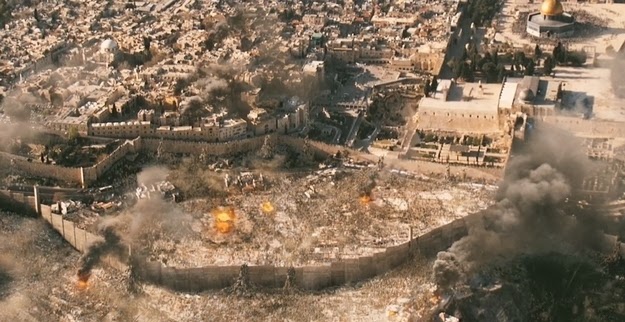
The setting of Dr. Fassbach's Nature lesson is hardly coincidental. World War Z is in part, in fact, a startling and savage critique of modern air travel.Earlier in the film, Gerry Lane's former boss Thierry Umutoni, U.N. Deputy Secretary-General (played by Fana Mokoena), briefs Lane on the situation and mentions offhand, concerning the virus, that "the airlines were the perfect delivery system..."
Later in the film, Gerry Lane barely escapes an overrun Jerusalem, enplaning onto a Belarus Airways wide-body jetliner at the last second before it takes off.
Lane makes it out in the nick of time: from the airplane window on ascent, we see the teeming masses of zombies and the devastation below.
Never mind: everything seems fine on the flight—a little relief, at last. That is, until the plane is making its descent into Cardiff, Wales, and Lane hears/feels some thumping toward the back of the plane. He cautiously strolls down the aisle to check it out.
What I want to seize on here is the total banality of this scene: it is the pinnacle of modern progress, summed up in the interior space of the commercial airliner. But when Lane peeks through the divide that separates Business from Economy Class, he sees an awful sight: there was a zombie stowaway on the plane that finally broke loose from the nether regions of the aircraft, and is wreaking havoc and thus multiplying.
Now having worked at an airport for a few years earlier in my life, I am fairly sympathetic to the grueling labor of air travel, and I do not wish to make fun of airline workers. But this sequence seems to me to be a clear jab: is this look so distinct from how we encounter (or at least hyperbolically imagine) irate, snippy flight attendants in so many mundane disciplinary contexts onboard commercial airliners? Sir, turn that phone off immediately!
At this point Lane's only recourse is to hurl a hand-grenade (how he got it is another story, not important for our purposes here) back toward Economy section of the cabin, and duck. This rather takes care of the immediate zombie problem, but it doesn't bode well for the plane.
And here we are back at Nature, which arrives in pristine form around a stunningly spectacular plane crash:
This is something I have written about elsewhere, but it is as if to say, You want Nature? You got it! It's all around: in the mountains, the white barked aspens, the firs and pines, the heavy clouds—it's a ridiculously scenic vista, re-marked as it were as a 'scene' where Nature really resides. Human flight always comes crashing back to the ground. The wild landscape frames this disaster, and clears away something of a blank slate for the human subject qua survivor, in the singular form of Brad Pitt.***
The tree trunk in the foreground of this shot reminds us that here, amid the redundant wire tangles and calamitous wreckage, we're in the realm of Nature. This is where we can start fresh, back at ground zero. It is no wonder that the crash scene is precipitated by a sequence that wonderfully and uncannily calls to mind Edward Norton's own mid-air collision fantasy in Fight Club:
parallel plane crash fantasies in World War Z and Fight Club
These are fantasies of getting back to Nature, to real experience—in Thoreau's words, "Contact! Contact!" Yet if we really wanted this immediacy in the context of World War Z, we would need only allow ourselves to be bitten. The zombies aren't struggling against—or to get closer to—Nature. They are it. As are we.
And here is the harsh critique of air travel: just when we thought we were farthest from Nature, nestled in our elaborate techno-cultural tubes of flight, we were in fact closer than ever to it. We can fly, but we cannot hide. Work that into your Nature lecture, Dr. Fassbach.
--
* It really doesn't look all that unfamiliar to other forms of life we know. For instance, Baz Luhrman's sick and gas-pumping "Wilson" (on the left, below) in The Great Gatsby adopts a similar posture and aura. And as in Elizabeth Bishop's poem "Filling Station," we discover an eccentric ecosystem thriving at this greasy juncture.
** You desire to LIVE "according to Nature"? Oh, you noble Stoics, what fraud of words! Imagine to yourselves a being like Nature, boundlessly extravagant, boundlessly indifferent, without purpose or consideration, without pity or justice, at once fruitful and barren and uncertain: imagine to yourselves INDIFFERENCE as a power—how COULD you live in accordance with such indifference? To live—is not that just endeavouring to be otherwise than this Nature? Is not living valuing, preferring, being unjust, being limited, endeavouring to be different? And granted that your imperative, "living according to Nature," means actually the same as "living according to life"—how could you do DIFFERENTLY? Why should you make a principle out of what you yourselves are, and must be? In reality, however, it is quite otherwise with you: while you pretend to read with rapture the canon of your law in Nature, you want something quite the contrary, you extraordinary stage-players and self-deluders! In your pride you wish to dictate your morals and ideals to Nature, to Nature herself, and to incorporate them therein; you insist that it shall be Nature "according to the Stoa," and would like everything to be made after your own image, as a vast, eternal glorification and generalism of Stoicism! With all your love for truth, you have forced yourselves so long, so persistently, and with such hypnotic rigidity to see Nature FALSELY, that is to say, Stoically, that you are no longer able to see it otherwise—and to crown all, some unfathomable superciliousness gives you the Bedlamite hope that BECAUSE you are able to tyrannize over yourselves—Stoicism is self-tyranny—Nature will also allow herself to be tyrannized over: is not the Stoic a PART of Nature?... But this is an old and everlasting story: what happened in old times with the Stoics still happens today, as soon as ever a philosophy begins to believe in itself. It always creates the world in its own image; it cannot do otherwise; philosophy is this tyrannical impulse itself, the most spiritual Will to Power, the will to "creation of the world," the will to the causa prima. (trans. Helen Zimmern)
*** The nexus of Brad Pitt and crashing is a topic I take up at greater length in Deconstructing Brad Pitt.
Subscribe to:
Posts (Atom)